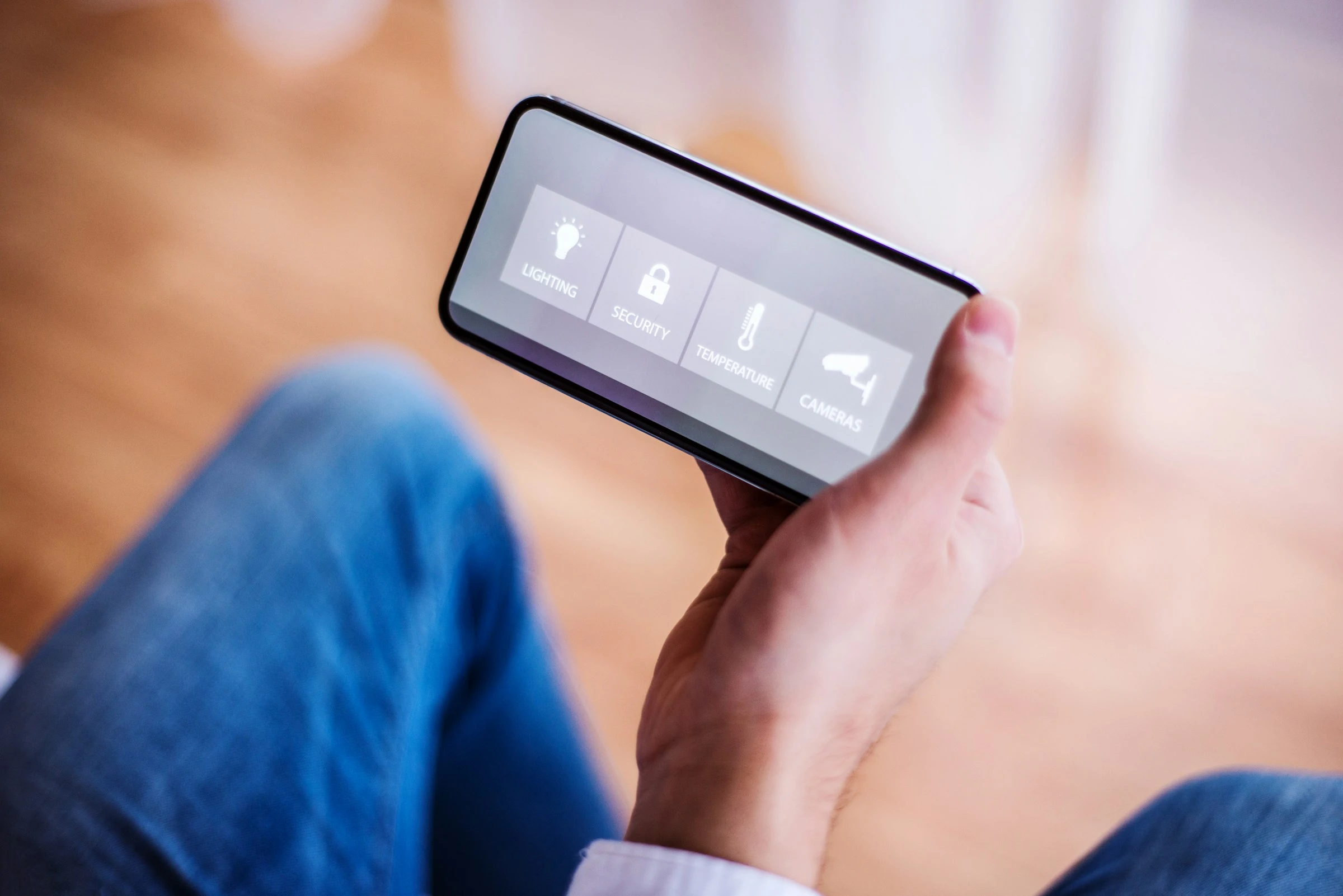
Commercial property security has undergone a quiet revolution over the past decade. The analogue systems that once defined the industry, standalone CCTV recorders, basic PIR alarms, and mechanical key locks, are being replaced by interconnected smart platforms that can detect, verify, and respond to threats with minimal human involvement. For commercial landlords and property managers, understanding what these systems offer is becoming essential.
From Analogue to Smart: What Changed
Traditional security systems operated in silos. A CCTV system recorded footage to a local DVR that someone had to physically check. An alarm system triggered a sounder and maybe sent a signal to a monitoring centre. Access control meant a set of keys or perhaps a basic keypad. Each system did its job independently, and none of them talked to each other.
Smart security systems change this by connecting every component onto a single platform, usually accessible via a web dashboard and mobile app. Cameras, alarms, access control, environmental sensors, and even lighting can be managed from one interface. When the alarm triggers, the relevant camera feed is pulled up automatically. When an access card is used at the front door, the system logs who entered, at what time, and can adjust lighting and HVAC settings accordingly.
This integration is not just convenient. It fundamentally changes how quickly threats are identified and how effectively they are resolved.
AI-Powered Video Analytics
The biggest leap in smart security has come from artificial intelligence applied to video surveillance. Modern IP cameras do not simply record; they analyse what they see in real time.
Intelligent motion detection. Traditional motion-triggered cameras are notoriously prone to false alarms. Animals, moving shadows, headlights, and swaying branches all trigger recordings. AI-powered analytics distinguish between a person, a vehicle, and environmental movement. The system can be configured to alert only when a person enters a defined area outside of business hours, dramatically reducing false alarms and ensuring that genuine threats receive immediate attention.
Facial recognition. Higher-end systems can identify known individuals from a database, automatically granting access to authorised personnel and flagging unknown faces. This has obvious applications for commercial buildings with multiple tenants, where managing physical access across dozens or hundreds of people becomes complex. It is worth noting that facial recognition in commercial settings must comply with the UK GDPR and the Data Protection Act 2018, and requires a clear lawful basis and a Data Protection Impact Assessment.
Automatic number plate recognition (ANPR). For commercial properties with car parks, delivery yards, or vehicle barriers, ANPR cameras read and log every number plate entering and leaving the site. The system can maintain a whitelist of authorised vehicles and flag anything unrecognised. For logistics sites and distribution centres, this provides both security and operational data.
Behavioural analytics. Some systems go further, detecting unusual behaviour patterns such as loitering, abandoned objects, or people moving in unexpected directions. While still maturing, these capabilities are particularly relevant for retail parks, office campuses, and other multi-use commercial sites.
Cloud vs On-Premise Systems
One of the key decisions when specifying a smart security system is where the data lives and where the processing happens.
On-premise systems store all footage and data locally on network video recorders (NVRs) installed at the property. The advantages are full control over your data, no ongoing cloud subscription costs, and no dependency on internet connectivity for core recording functions. The disadvantages are that hardware must be maintained and eventually replaced, local storage is vulnerable to theft or damage, and remote access requires VPN configuration or port forwarding.
Cloud-based systems stream footage to remote servers managed by the provider. This means footage is safe even if the on-site equipment is stolen or destroyed. Software updates and AI model improvements are applied automatically. Scaling up is straightforward because adding cameras does not require additional local storage. The trade-off is an ongoing subscription cost and a dependency on reliable internet bandwidth, which can be a limiting factor for some commercial sites.
Hybrid systems combine both approaches: recording locally for reliability while syncing critical footage and alerts to the cloud. For most commercial properties, a hybrid approach offers the best balance of resilience, cost, and convenience.
Integrated Security Platforms
The real power of smart security emerges when individual components work together as a unified system. A well-designed integrated platform connects CCTV, intruder alarms, access control, intercom systems, fire detection, and environmental monitoring into one management layer.
Consider a practical scenario: at 2am, a door sensor on a commercial unit triggers. The system automatically pulls up the nearest camera feed, which shows an individual attempting to force entry. The AI confirms this is a person, not a false alarm. The system sends a push notification to the property manager's phone with a video clip, simultaneously alerts the monitoring centre, and activates an audio warning through an on-site speaker. The monitoring centre verifies the threat and dispatches a response. All of this happens within seconds, without anyone needing to review hours of footage or manually cross-reference different systems.
This level of integration used to require expensive, bespoke installations. Today, several commercial-grade platforms offer it as a standard feature set, making it accessible to a much wider range of commercial properties.
Remote Management via Mobile
For commercial landlords and property managers overseeing multiple sites, remote management capability is arguably the most valuable feature of modern smart security. From a single mobile app, you can:
- View live and recorded camera feeds from any site
- Receive instant alerts with video verification
- Lock or unlock doors remotely
- Grant or revoke access credentials for tenants, contractors, and staff
- Monitor environmental conditions such as temperature, humidity, and water leaks
- Generate access reports and incident logs
This is particularly useful for vacant or between-let properties, where there is no on-site presence but constant oversight is still needed. Rather than relying solely on periodic physical inspections, a property manager can check on a building from anywhere, at any time.
Cost-Benefit for Commercial Landlords
Smart security systems typically carry a higher upfront cost than basic analogue equivalents. A fully integrated system for a mid-sized commercial building might cost between five thousand and twenty thousand pounds to install, depending on the number of cameras, access points, and sensors involved. Cloud-based platforms add a monthly subscription, typically fifty to two hundred pounds per month depending on the number of devices and storage requirements.
However, the return on investment tends to be strong. Reduced false alarm callout charges, lower insurance premiums (many insurers offer discounts for monitored smart systems), reduced need for physical guarding, faster incident response, and lower theft and damage losses all contribute. For a commercial landlord managing a portfolio, the operational efficiency gains of managing all sites from one platform can justify the investment on their own.
There is also a tenant retention angle. Businesses choosing commercial premises increasingly expect modern security as standard. A building with a well-specified smart security system is a more attractive proposition than one relying on outdated equipment.
Future Trends
The smart security market is evolving rapidly. Several trends are worth watching:
- Edge computing. More processing is moving onto the cameras themselves, reducing bandwidth requirements and enabling faster real-time analysis even with limited connectivity.
- Predictive analytics. AI systems are beginning to identify patterns that suggest future risk, such as repeated reconnaissance visits, rather than simply reacting to events as they occur.
- Integration with building management systems (BMS). Security is merging with broader building operations, linking access control with HVAC, lighting, and energy management for smarter, more efficient buildings overall.
- Cybersecurity. As systems become more connected, securing the security system itself becomes critical. Expect to see more emphasis on encrypted communications, zero-trust architectures, and regular security audits of IoT devices.
For commercial property owners, the direction is clear. Smart security is no longer a premium option for high-value assets. It is becoming the baseline expectation. The technology is mature, the costs are falling, and the operational benefits are proven. The question is not whether to upgrade, but when.
Upgrade Your Commercial Security?
We design and install smart security systems tailored to commercial properties. Get a free site assessment.